
Mold Remediation in Bothell, WA
We find where the water is coming from, seal the area off, physically remove the mold, and have an independent tester confirm it's gone before anything gets rebuilt. Most Bothell jobs are crawl spaces, attics, bathrooms and water-damaged walls, and most take 1 to 5 working days. You get a written price range before any work starts.
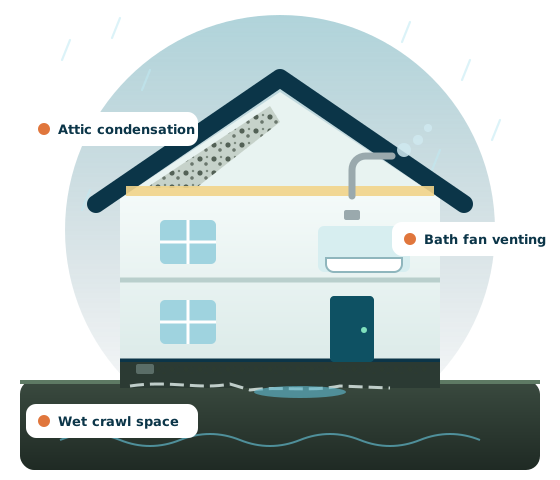
We find the water first
Moisture meters, thermal imaging, and a look in the crawl space and attic, not just the wall you noticed.
Written range up front
A line-item scope after the inspection, so you can compare quotes properly.
Contained, clean work
Plastic containment, HEPA negative air and a clean house outside the work area.
We don't grade our own work
An independent tester signs off before the plastic comes down.
Mold is the symptom. Moisture is the problem.
Mold almost always means water has been getting somewhere it shouldn't, usually for a while. Here's where it shows up around here, and what fixing it involves.
Crawl space mold
White or dark growth on joists and subfloor, a torn or missing vapor barrier, a musty smell in the rooms above. We clean the framing, then fix the moisture with a new vapor barrier or encapsulation.
Crawl space remediationAttic mold
Dark staining on the roof sheathing, usually worst on the north side. In our wet winters it usually comes from bath fans or dryer vents dumping warm, damp air into the attic, or from blocked eave vents.
Attic remediationMold after a leak or flood
Burst pipes, roof leaks, and river or creek flooding. Wet drywall and insulation can start growing mold within 24 to 48 hours, so the first two days matter most.
Water damage moldBathroom & shower mold
Behind tile, under vanities and around tubs. Common in Bothell condos and apartments, where a neighbor's leak can be the source.
Bathroom mold removalBasement & wall mold
Water coming in at doors, windows or the foundation, carpet pad holding moisture, and growth behind drywall and baseboards.
Basement remediationA musty smell you can't trace
That smell is gas given off by actively growing mold. We track it to the source with moisture meters and thermal imaging instead of guessing.
Mold inspectionLong wet winters, 1970s–90s houses, and a city built around a river
Three things stack up here. Each one on its own is manageable. Together they explain why so many Bothell calls start between October and March.
The wettest month. December and January run close to 4–5 inches. August gets under an inch.
Crawl spaces and attics soak it up from October on, and indoor temperatures keep mold active all winter.
About half of Bothell homes went up between 1970 and 1999, most on vented crawl spaces.
King County photographed the river out of its banks at the Park at Bothell Landing.
Sources: timeanddate climate averages, City-Stats / Census ACS, NeighborhoodScout, King County Flood Control District.
Why does my house smell musty every fall?
Because the rain comes back. Crawl spaces and attics pick up moisture from October on, and the smell follows a few weeks later. Indoor temperatures stay in the 60s and 70s all winter, so mold never really goes dormant.
Does the age of my house matter?
Yes. Split-levels and ramblers from the '70s, '80s and '90s usually sit on vented crawl spaces with thin plastic vapor barriers that tear, shift or were never fully laid. Their attics often have bath fans vented into the insulation instead of outside. Newer homes in Canyon Creek, North Creek and Bothell East have different problems: tight walls that trap leaks from windows and sliders, and lumber that was closed in while still wet.
Does living near the river or creeks make it worse?
It can. The Sammamish River runs through downtown Bothell, North Creek joins it near the UW Bothell campus, and Swamp Creek comes in from the north. High groundwater along these corridors means wetter crawl spaces. In past storms, North Creek has flooded the North Creek Business Park and parts of 120th Ave NE and 228th St SE.
Rule of thumb: if a smell or stain comes back every winter and fades every summer, you're looking at a moisture pattern, not a one-off spill. That's what the inspection is for.
The IICRC S520 way: remove it, don't paint over it
We follow the IICRC S520, the industry's ANSI-accredited standard for mold remediation. Its core rule is simple: mold has to be physically removed. Killing it with a spray isn't enough, because dead mold can still cause allergic reactions.
Inspect and find the water
Moisture meters, thermal imaging, and a look at the crawl space, attic and HVAC. If we don't find the source, the mold comes back.
Set up containment
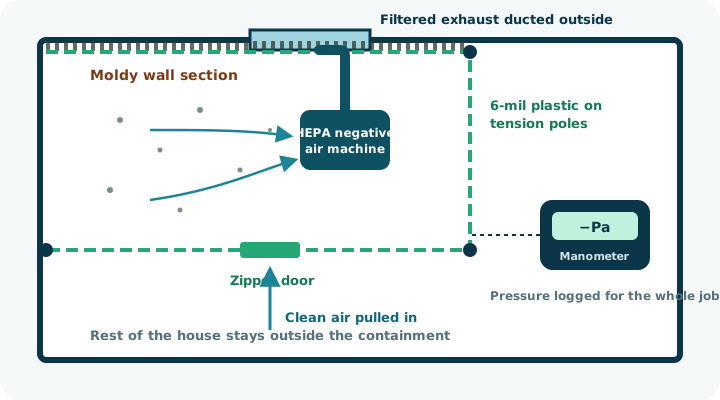
We seal the work area with 6-mil plastic on tension poles and zipper doors, so spores don't spread to the rest of the house.
Put the area under negative pressure
A HEPA negative air machine pulls air out of the containment and exhausts it outside, so air flows in, not out. A manometer tracks the pressure for the whole job.
Remove what can't be saved
Moldy drywall, insulation and carpet come out bagged. Baseboards and trim come off too, because the worst growth is usually behind them.
Clean what can be saved
Framing, joists and subfloor are sanded, wire-brushed or blasted, then cleaned with HEPA vacuuming, damp wiping and HEPA vacuuming again.
Verify, then rebuild
An independent tester checks the area before the plastic comes down. Only after it passes do we seal, encapsulate if needed, and put things back.
What we won't do
- Spray or fog chemicals instead of removing mold
- Paint or encapsulate over mold before clearance testing
- Use bleach on drywall or wood. It whitens the surface and leaves the roots
- Run an air scrubber with no negative pressure and call it containment
- Leave baseboards and trim in place on a water-damaged wall
- Work in N95 masks. Our crew wears full-face respirators
What does mold remediation cost in Bothell?
Most Bothell jobs land in the low thousands. Small bathroom jobs start lower, and whole crawl spaces with encapsulation or flood-damaged rooms run higher. You get a written, line-item range after the inspection, before any work starts.
For reference, published Seattle-area ranges run about $800–$2,400 for a small bathroom, $1,500–$5,500 for a crawl space and $2,000–$8,500 for a basement. HomeAdvisor lists a $1,926 average for Bothell mold jobs.
Why did I get quotes from $500 to $20,000?
Because the companies aren't quoting the same job. A low number is often a spray or fog with no containment and no testing. A high number may include rebuilding, contents cleaning or work that isn't needed. What actually sets the price:
- How many square feet are affected, and what kind of material (drywall comes out, framing gets cleaned)
- Access: a 24-inch crawl space or a low attic takes longer than a basement wall
- Whether the moisture fix is included (vapor barrier, venting, leak repair)
- Containment size and how long negative air has to run
- Independent clearance testing and any retesting
- Rebuild: drywall, insulation, paint and trim
Ask every company to break its quote out by those lines. If one won't, that tells you something.
We don't grade our own work
An independent tester signs off on every job, not us. Washington has no state mold license, so the clearance test is the one objective check you get. Having a separate company do it removes the obvious conflict of a remediator testing its own work.
We inspect and scope the job. If you want lab testing first (air samples, tape lifts or an ERMI dust test), we'll point you to an independent tester or work from the report you already have.
Post-remediation verification happens before the containment comes down: usually air samples inside the work area compared with an outdoor sample, plus surface samples.
Your contract states what a passing result means, so there's no argument later about whether the job is done.
A lot of Bothell mold calls start with an inspection report
Here's what matters for each side of the deal. This is general information, not legal advice.
Selling: what about Form 17?
Washington sellers fill out the Form 17 seller disclosure statement (RCW 64.06), and known mold or past mold work belongs on it. Fixing it properly before you list, with photos, moisture readings and a passing clearance report, gives buyers something concrete instead of a question mark.
Selling a house with moldBuying: the inspector found mold
Get it scoped before you agree on a credit. A wet basement wall and a crawl space full of growth are very different jobs, and a quick number from the inspector is often off. We can inspect during your inspection window and give you a written range to negotiate with.
Pre-purchase mold inspectionsRenting: who's responsible?
Under RCW 59.18.060, Washington landlords must keep units reasonably weathertight and give tenants Department of Health information about mold. Tenants should report leaks and moisture in writing. We work with landlords and property managers on occupied units and document everything for both sides.
Talk to us about a rentalThe first 48 hours decide whether you get mold
After a leak or flood, you have about 24 to 48 hours before wet drywall, carpet pad and insulation start growing mold. What you do in that window matters more than anything that happens after.
- Stop the water and shut off power to wet areas if it's safe to.
- Take photos and video of everything before anything is moved or thrown out. Your insurer will ask.
- Get wet materials out or drying fast. Fans alone on a wall that's already growing mold spread spores. If you can see or smell mold, call before you start drying.
- Call your insurance company and ask specifically about mold coverage and any mold limit.
Does homeowners insurance cover mold in Washington?
Sometimes. Washington's Office of the Insurance Commissioner notes that most policies don't cover mold, and some offer limited coverage. Coverage usually depends on whether a sudden, covered event caused it, like a burst pipe, rather than a slow leak or long-term humidity. River and creek flooding isn't covered by a standard homeowners policy at all; that needs separate flood insurance.
We document the cause, the extent and the scope in a way adjusters can use. Mold insurance claims in Washington
All of Bothell, both sides of the county line
Bothell sits in two counties, and we work both. Downtown and the south end are in King County (98011). Canyon Park, Thrasher's Corner and the north end are in Snohomish County (98012 and 98021).
Canyon Park & Canyon Creek
1990s–2000s subdivisions and condos around the business park and North Creek, plus the newer Canyon Creek subdivisions south of Maltby Road.
North Creek & Bothell East
Newer construction, creek-side lots, and flooding along 120th Ave NE and 228th St SE.
Downtown, Riverfront & Westhill
Older homes near Main Street and Bothell Way NE, and the riverside streets along the Sammamish River.
Thrasher's Corner & Red Hawk
Along the Bothell-Everett Highway (SR 527) and SR 524 toward Mill Creek.
Queensborough, Brentwood & Crystal Springs
Near Swamp Creek and Wallace Swamp Creek Park.
Maywood, Norway Hill & Queensgate
Hillside and King County-side neighborhoods north and south of downtown, including Beckstrom Hill and Brickyard Road.
Also Shelton View, Fitzgerald and Country Village / Lake Pleasant, plus nearby Kenmore, Woodinville, Mill Creek, Kirkland and Maltby. See the full service area
Check credentials before you hire anyone
Washington has no state mold license, so ask any remediator for three things before you hire them: an active WA L&I contractor registration, IICRC mold certification (AMRT) for the people doing the work, and proof of liability insurance.
The person who inspects your house should be able to explain the moisture source, the scope and the price in plain English, and put it in writing. That's the standard we hold ourselves to. More about us
Can you remove mold yourself?
Sometimes. The EPA says a homeowner can usually clean an area smaller than about 10 square feet (roughly 3 by 3 feet) if the moisture problem is fixed and nobody in the house has asthma, allergies or a weakened immune system. Wear at least an N95, gloves and goggles.
Call a professional when:
- It's bigger than about 10 square feet, or you keep finding more
- It's in drywall, insulation, carpet or the HVAC, not on tile, glass or metal
- It came from sewage, river or creek water
- You smell it but can't find it
- Someone in the home is sick, pregnant, elderly or immune-compromised
- You're selling, buying or dealing with a landlord, and need documentation
Skip the bleach on drywall and wood. It takes the color out of the surface but leaves the roots, and the water in it feeds what's left.
Mold remediation questions we hear in Bothell
How much does mold remediation cost in Bothell?
Most Bothell jobs fall in the low thousands of dollars. Published Seattle-area ranges run about $800–$2,400 for a small bathroom, $1,500–$5,500 for a crawl space and $2,000–$8,500 for a basement. Price depends on the area affected, access, whether the moisture fix is included, and clearance testing. You get a written, line-item range after the inspection. Full cost guide
How long does mold remediation take?
Most residential jobs take 1 to 5 working days on site, plus time for clearance results. Large crawl spaces, flood damage or HVAC work can take longer. You get a schedule before work starts.
Can I stay in my house during remediation?
Usually yes, when the work is in a crawl space, attic or closed-off room that's under containment and negative pressure. If the work is in your main living space, or someone in the home is sensitive to mold, plan to stay elsewhere until clearance passes.
Do you test your own work?
No. An independent tester does post-remediation verification before the containment comes down. That's on purpose: the company that removes the mold shouldn't be the one that says it's gone. How clearance testing works
Will the mold come back?
Not if the moisture source is fixed and indoor humidity stays below about 60%. The EPA recommends 30–50% where you can. Mold spores are always in Bothell's outdoor air, so a new leak or a wet crawl space will start growth again. Any warranty excludes new water events, so read the terms.
Does homeowners insurance cover mold?
It depends on the cause and your policy. A sudden, covered event like a burst pipe may be covered, often with a mold limit. Slow leaks, long-term humidity and flood water usually aren't. Call your insurer and ask us for documentation. More on insurance claims in Washington
Is black mold dangerous?
You can't tell how harmful mold is from its color, and you don't need to know the species to remove it. Any mold growing indoors can trigger allergy and asthma symptoms, and people with weakened immune systems face higher risk. If you have symptoms, talk to your doctor. We remove all mold the same way.
Does bleach kill mold?
It can kill surface mold on hard, non-porous surfaces like tile. On drywall and wood it doesn't reach the roots, and dead mold still causes reactions. Proper remediation removes the mold rather than killing it in place.
Do I have to disclose mold when selling a home in Washington?
Known mold and past mold remediation belong on the Form 17 seller disclosure statement. A clearance report from a properly done job is the best thing you can hand a buyer. This is general information, not legal advice. Selling a house with mold
Do you work outside Bothell?
Yes. Along with every Bothell neighborhood on both the King and Snohomish County sides, we serve nearby Kenmore, Woodinville, Mill Creek, Kirkland, Brier, Lynnwood and Maltby. See the service area
Not sure what you're dealing with?
Send a few photos and tell us where it is. We'll tell you honestly whether it's a DIY job or a professional one, and give you a rough range before anyone drives out.