
The short version: find and fix the moisture, seal the work area and put it under negative pressure, physically remove the mold, clean what stays with HEPA equipment, dry it, and have an independent tester confirm it's clear before rebuilding. Mold is removed, not sprayed, fogged or painted over.
The standard we work to
The IICRC S520 is the ANSI-accredited standard for professional mold remediation in the United States. There is no federal regulation for residential mold remediation, and Washington has no state mold license, so the standard is the best measure of good work. Its central point, repeated throughout, is that physically removing mold is the primary means of remediation. Killing mold with a biocide doesn't remove its allergenic properties, so dead mold left in place can still cause reactions.
Step 1: Inspection and scope
We inspect the problem area and the places mold usually hides in Bothell homes: crawl spaces, attics, bathrooms and HVAC. Moisture meters and thermal imaging map how far the water went. You get a written scope listing the moisture source, the materials and square footage affected, what will be removed and cleaned, the moisture fix, the clearance criteria and a price. More on our inspections.
Step 2: Containment and negative pressure
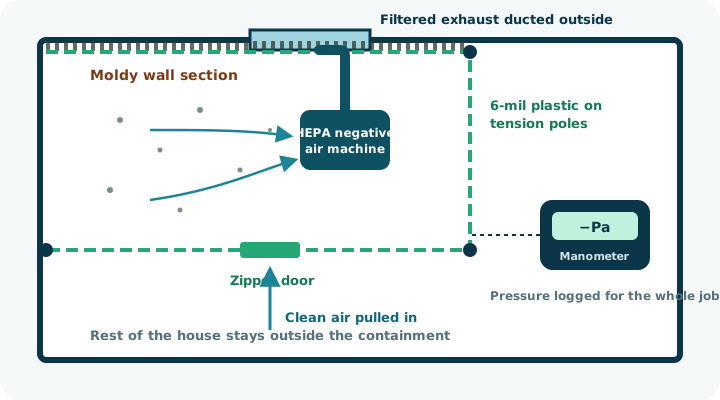
Disturbing mold releases enormous numbers of spores. Containment keeps them in the work area:
- 6-mil plastic sheeting held floor to ceiling with tension poles and taped at every edge
- Zipper doors for entry, and on bigger jobs a decontamination chamber
- A HEPA negative air machine ducted outside, so air is always pulled into the containment rather than leaking out
- A manometer to monitor the pressure difference throughout the job, because pressure drops as walls get opened
- HVAC sealed off in the work area, so the furnace doesn't spread spores through the ducts
Air scrubber vs. negative air machine: they're often the same type of HEPA unit. An air scrubber recirculates air inside a room. A negative air machine exhausts outside, which is what creates negative pressure. If a proposal only mentions an air scrubber, ask whether the containment will actually be under negative pressure.
Step 3: Removal
Everything in a house falls into one of three groups, and the group decides what happens to it:
| Material type | Examples | What we do |
|---|---|---|
| Porous | Drywall, insulation, carpet and pad, ceiling tiles | Remove and bag. Mold grows into these and can't be cleaned out. |
| Semi-porous | Studs, joists, subfloor, roof sheathing, concrete | Clean in place by sanding, wire-brushing or blasting off the surface growth. Rotted wood is replaced. |
| Non-porous | Metal, glass, plastic, ceramic tile | Clean and wipe. |
Baseboards and trim come off any water-damaged wall. Water runs down, so the worst growth is usually at the bottom of the wall, behind them.
Step 4: Cleaning
After removal, settled dust and spores coat every surface inside the containment. Negative air keeps them in, but it doesn't clean. Cleaning is detailed hand work:
HEPA vacuum
Every surface: framing, floors, pipes, wires and ducts in the work area.
Damp wipe
Surfaces wiped to pick up fine particles a vacuum leaves behind.
HEPA vacuum again
A final pass. On sensitive jobs we repeat the wipe and vacuum.
Step 5: Moisture correction and drying
The fix depends on the cause: a new vapor barrier or encapsulation in the crawl space, bath fans ducted outside and eave vents opened in the attic, a plumbing repair, or drainage changes outside. Materials are dried with dehumidifiers until they reach normal moisture readings, and we log the numbers.
Step 6: Independent clearance, then rebuild
Before the plastic comes down, an independent tester inspects the area and usually takes air and surface samples. If it passes, any sealer goes on, then insulation and drywall. If it fails, we re-clean and it's retested. How clearance testing works.
What we won't do
- Fog or spray chemicals as a substitute for removal. The S520 advises against fogging in place of source removal.
- Encapsulate or paint over mold before clearance testing
- Use bleach on drywall or wood
- Call an air scrubber with no negative pressure "containment"
- Point fans at moldy materials
- Work without full-face respirators
Questions to ask any mold company
- Will the containment be under negative pressure, and how will you monitor it?
- Exactly which materials come out, and which get cleaned?
- What's the moisture fix, and who's doing it?
- Who does the clearance test, and what counts as a pass?
- What does your warranty exclude?
- Can I verify your WA L&I contractor registration?